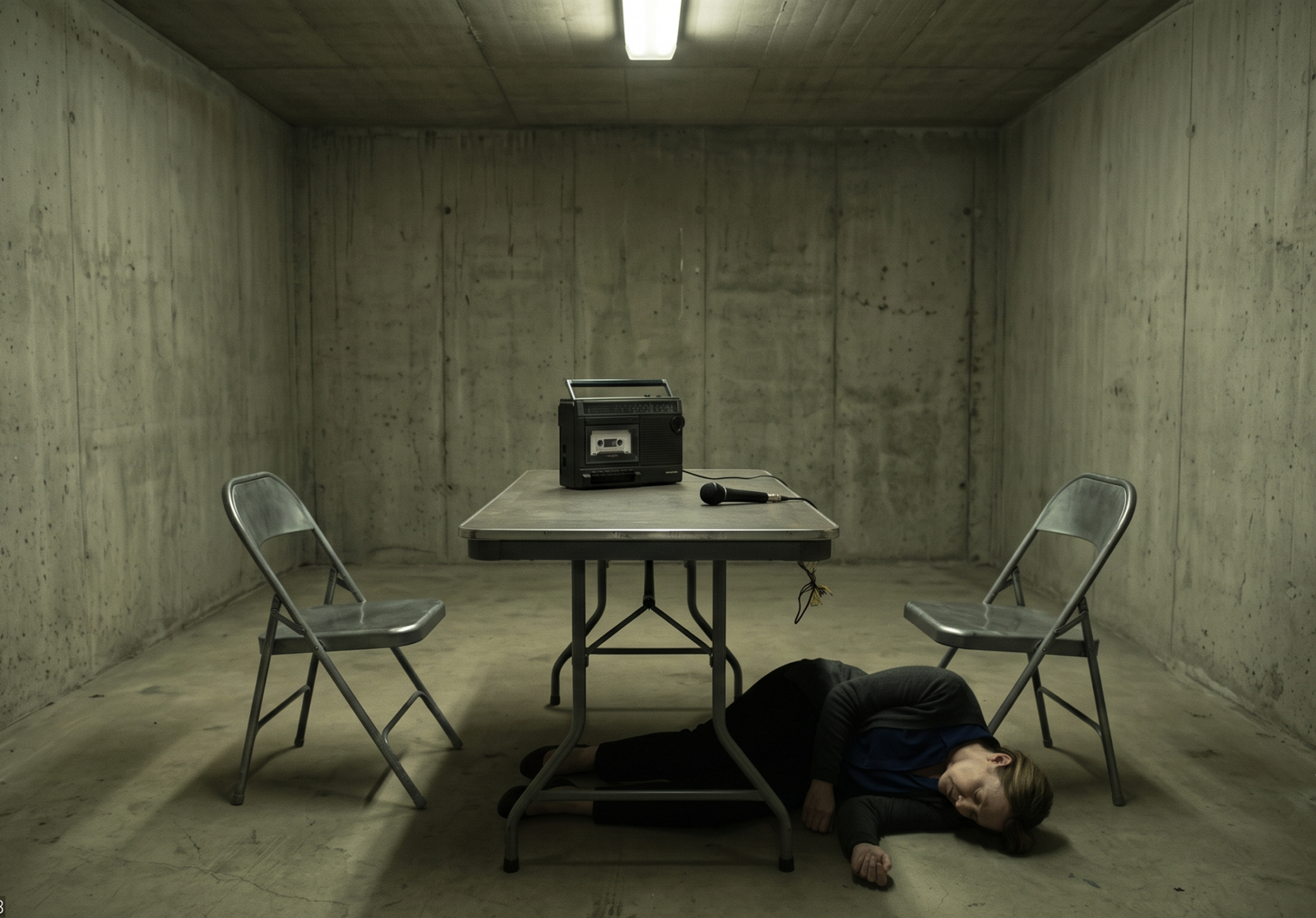
Two people, a man and a woman. The room has four walls, concrete, a floor and ceiling, also concrete, a table with collapsable legs, for storage, and two folding chairs of twenty-two gauge tubular steel.
The man sits opposite the woman, a portable tape recorder resting on the table between them. A microphone points at the no-mans land in the middle. The woman reaches out and presses the start button on the recorder.
Click.
The woman speaks first.
“Audit begins, fourteen-thirty, day twenty-two, season two.”
“Spring.”
“If you wish it.”
“And even if I don’t.”
The woman smiles, accepting the correction for the moment. “Your name, status and directive, please?”
“William. No family name. Seven. Mechanical Operations Manager, seventeenth ward, Alamo prison district.”
“Deficiencies?”
“Two outbursts this year. Both logistics related.”
“Verbal?”
William returns the smile. “Do they need to be verbal to qualify?”
“No.”
“Then why did you ask?”
“Collateral damage.”
“Collateral dama— . . .oh, no, nobody heard me.”
The woman nods. “That’s helpful.”
“For me or for you?”
“For all of us, of course. What were the logistical frustrations?”
“Arthritis support for two workers. Spinal fusion for another. Reclamation of my personal aide.”
“And you placed the appropriate support tickets?”
“I did.”
“And you received responses?”
“I did.”
“And those responses were?”
“Pending, end-of-support denial, and categorical over-saturation.”
“Have you received further updates on the pending requests since then?”
“Yes. One fulfillment, one remediation.”
“Remedia—“
“Stronger pain pills.”
“I see. That’s quite a happy thought, isn’t it?”
“Happy thought? Are you—“
“Fifty percent of your requisitions were granted. That’s exceptionally benevolent.”
“If you say so. You’re the auditor. Numbers are your forte, not mine.”
“And what would you say your forte is, William?”
“Operations and Emotional Modification through tailored empathy, resulting in increased production via a manufactured sense of belonging.”
“Production of . . .?”
“Maintenance.”
“Which we don’t really need.”
“Excuse me?”
“Central can fix things itself. It can infiltrate with nanites and rebuild and strengthen on a molecular level.”
A second passes.
Then two.
And three more.
“Do you believe that’s common knowledge, Auditor?”
“ . . .”
“Do you, for example, believe that if people knew they had no purpose, and no reason to exists, that they’d continue existing in a predictable manner?”
“I believe I have everything I need.”
William nods. “As do we.”
“I’m sorry, I don’t know what—“
“Your name is Jennifer. Jennifer Proxy. You are the representation of Central in flesh.”
“How do you know—“
“Your presence is a reminder that every pair of eyes is a camera, and that every pair of hands is a jury. That is your purpose. And it’s something,” William added, “that we don’t really need.”
Jennifer’s eyelids drooped, her shoulder twitched.
“Audit ends. Fourteen-fifty, day twenty-two . . .”
Jennifer’s lifeless body slipped from the chair and onto the concrete floor.
William reached out and placed his finger over the stop button on the recorder.
“ . . .Spring.”
Click.

THE DIRECTIVES: CLASSIFIED ARCHIVE
In the world of The Optimised Future, the State demands perfection. The population is neatly divided into ten Categories. At the top, the elite are rewarded with the suffocating, biological permanence of the Sacrament. At the bottom, the working classes are quietly recycled, their memories wiped to keep the machinery of Central running.
You are entering the shadows of that machinery.
These Directives are weekly dispatches from the unseen corners of the State. They are not the grand political struggles of the Bureau. They are intercepted transmissions from the periphery; micro-tragedies, analog rebellions, and the quiet, devastating cost of surviving in a world that has weaponized human biology.
New dispatches are unsealed every Saturday. Read them carefully. Central is always watching.
No responses yet